IndieGent is the console, not the agent. It drives a coding-agent CLI installed on your own Mac under your own account — Claude Code, and Grok Build if you have it. No model subscription of ours, and nothing to paste into IndieGent.
requires git · gh · claude — grok optional
What runs on what
IndieGent 2.7.2
A session is one issue, one branch, and a workspace that did not exist this morning. IndieGent opens it, writes the brief, watches the work and ships the pull request. The agent is the part that writes the code — which is why the harness is yours, not ours.
Sessions
The work on your repos. Runs on whichever harness the project is set to.
Tank
The operator that sees every project and dispatches the work. Always Claude Code.
Scheduled runs
The overnight passes that come back with tomorrow's issues. Always Claude Code.
That last part is why Claude Code is required rather than merely supported: the console's own thinking runs on it, whatever an individual project is set to.
The honest part
What is the same, and what is not
Most of a session is IndieGent's own work, so most of it does not change with the harness. Two lines do, and one of them you will notice while you wait.
LineClaude CodeGrok Build
Sessions on your own reposClaude CodeYesGrok BuildYes
Headless — no terminal, no windowClaude CodeYesGrok BuildYes
Supervised, auto-edit, full autoClaude CodeYesGrok BuildYes
Reads your repo's own CLAUDE.mdClaude CodeYesGrok BuildYes
Model set per projectClaude CodeAny name the CLI acceptsGrok BuildAny id your account lists
Live status while the session runsClaude CodeYesGrok BuildNot yet
Runs Tank and scheduled runsClaude CodeAlwaysGrok Build—
A Grok session's row moves when you ship it, or when a background run's process finishes — there is no live progress in between. It is the one place the two genuinely do not feel the same, and we would rather say so here than have you find out at midnight.
Setup
Two commands each, once.
Both are ordinary CLIs you install and sign into yourself. IndieGent never sees either account — it checks only that the binary is on your PATH.
Claude Code
Required
The agent IndieGent is built around. Every project runs on it unless you say otherwise.
01Install
npm install -g @anthropic-ai/claude-code
02Sign in
claude
Sign in once, in the CLI itself. IndieGent never sees your Anthropic account — it checks only that claude is on your PATH.
Checked before the console opens
It sits in the first-run list beside git and the GitHub CLI. Anything missing is named, with the command to fix it.
Sessions report themselves
Progress comes back while the work is happening, so a row moves on its own — working, needs you, done — without you opening anything.
Any model you like
Set a default model per project, or run one session on a different one. IndieGent passes the name through; the CLI decides what it accepts.
Grok Build
Optional
If you already pay for Grok, a project can run on it instead. Everything around the session is unchanged: same workspace, same brief, same pull request at the end.
01Install
curl -fsSL https://x.ai/cli/install.sh | bash
02Sign in
grok login
Through the browser.
grok login --device-auth
A device code instead, for a machine with no browser.
XAI_API_KEY
Or an API key from console.x.ai, in your environment.
Its own row, outside the count
Grok Build appears on the first-run checklist under the required tools and is never counted against them. IndieGent does not report something missing because you don't use it.
A default per project
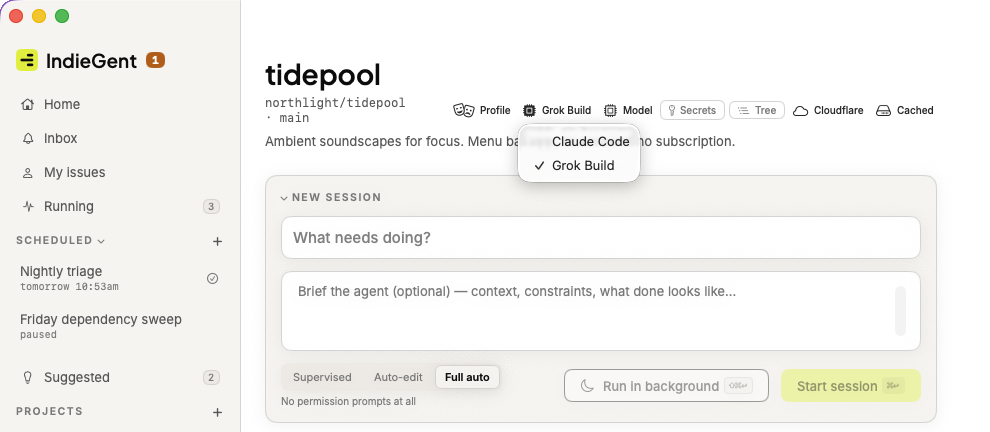
The chip in a project's header sets which harness its sessions run. Leave it alone and the project runs Claude Code.
Or just for this one
Ask Tank to dispatch a single issue on the other harness and it does; the project's default is left where it was.
Your Claude Code setup stays out of it
IndieGent runs Grok with its Claude-compatibility imports switched off, so the hooks, MCP servers and skills you configured globally for Claude Code do not follow you into a Grok session.
The choice
Where the choice is made
In the project's own header, next to its model and its workspace mode. Nothing set means Claude Code, so a portfolio you never touch behaves exactly as it did before Grok Build existed.
The chip in a project's header. Unset, it reads Claude Code; this repo is set to Grok Build. Shot from IndieGent 2.7.2 against a staged portfolio.
Pricing
The console is the same either way.
Seven days with every wall down, no card and no account. Then a single payment, on top of the agent you were already paying for.